
Editorial Anonymous provided a great explanation of basic picture book construction a few months ago.
At that time, I skimmed the info. Today, I’m studying it.
Why? An editor asked me to make page breaks on my current manuscript. And know what? I had more page breaks than a 32-page picture book would allow! Whoops. I knew that my manuscript had to fall within the 500- to 800-word length, but I had neglected to pay attention to logical page breaks.
The editor said, “Page turns can make or break a book, and it can be helpful to an editor to see how you envision the text.”
In a 32-page picture book, you don’t actually have 32 pages for your story. You only have 24 pages since 8 are used for the book ends, copyright and title. And 24 pages translates to 12 spreads (an illustration that spans the two opened pages in a book).
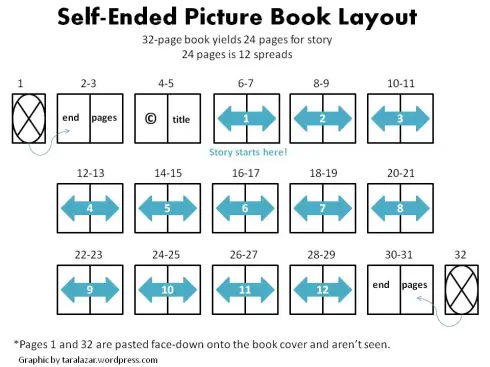
Self-ended means that the printed book block serves not only for the story, but also for the end pages. No additional paper is used to form the book. The printed book block is pasted directly onto the cover.
Another common format is colored ends. This means colored paper (different from the printed book block) is used for the end pages. With colored ends, you’ll gain an additional 2 1/2 spreads since more of the printed book block is available for story.
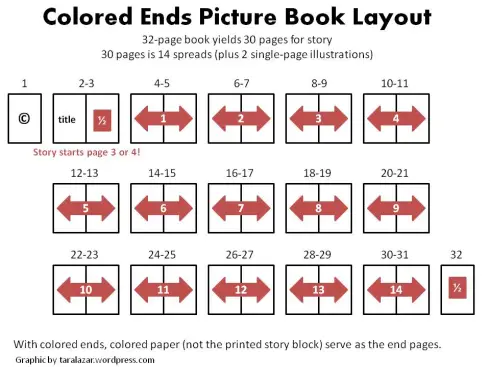
Some picture books have single-page illustrations instead of spreads. One of my favorite devices is when a group of three things are illustrated on one page. But this isn’t done on every page. A debut author’s work might be laid out only in spreads to save on costs (it’s less illustrations to produce), so you may want to think mostly in spreads. As always, publishing is a subjective industry, so this will vary by editor.
You may be asking, why do I need to know this? Won’t the editor and illustrator figure out the page breaks? Sure, they will. Some may not even ask for your page-break input. However, you can write a more appealing picture book if you understand the format for which you’re writing. Knowing the page turns will improve your story’s pacing. You’ll realize which scenes may have too much text. You can make page turns surprising and fun.
So give it a try. Take your current PB and plug it into the format. Does it fit?
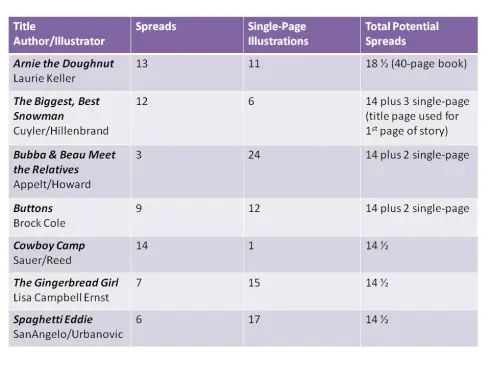
I just took a random sampling of 7 picture books from my collection. Interestingly, none had self-ended construction. They all had colored ends. Here’s how they broke down:
I don’t think I’ll ever look at a picture book the same way again. My kids are going to be frustrated if I count spreads while I read to them!
It’s interesting to note that Cowboy Camp and Spaghetti Eddie are both by debut authors. Cowboy Camp is illustrated in spreads, whereas Spaghetti Eddie is told with mostly single-page illustrations. This “illustrates” that publisher preferences vary (as do manuscripts)!
Keep in mind that when you submit your manuscript, you should do so in the standard format, unless the submission guidelines specifically request that you mark page breaks.
Some editors will never ask you for page breaks, some will insist upon them. Remember that this is a subjective industry where there are many rules to follow but many places to break them, too.








 Writing for Kids (While Raising Them)
171 comments
Comments feed for this article
February 23, 2009 at 1:03 am
Kelly H-Y
SO true … what great advice, and what a fabulous graphic you provided!
February 23, 2009 at 8:31 am
Corey
What a fantastic diagram you made. Can you do my powerpoint presentation for me? 🙂
P.S. I had always heard 14 or 14 and a half spreads.
February 23, 2009 at 9:43 am
tara
Corey, the 14 or 14 1/2 spreads is for colored ends. It depends upon the editor, I suppose, but this editor said her house preferred self ended construction.
February 23, 2009 at 11:03 am
Randi
Thank you, Tara! Very informative. I have to send this one onto my writing group. =D
February 24, 2009 at 1:00 am
duckofalltrades
This is great information. Thanks for sharing! It goes to show how many variables you have to consider when writing for children.
March 1, 2009 at 1:03 pm
Ginger Pate
It was so nice of Tara to share this with everyone.
I write PB and I sent this on to a teacher who’s classes I’ve attended and here is some more information. He said: “That seems like an interesting article. Most my author friends don’t use rigid models like that one to write/illustrate their books, however. But, it does serve as a good “heads up” tool for people who are not familiar with the format. Editors usually do all that work at the end.”
Ginger
March 2, 2009 at 10:23 am
tara
Thanks, Ginger. I was always told that the editor does this work on their end, but the editor I met with was adamant about knowing where your page breaks are. But this industry is subjective. Another editor may not want your input on page breaks. I do think it’s excellent information to know, but of course, your editor has the final say on where readers will turn the page. And I know of one case where the illustrator had the final say, and that’s probably not uncommon.
I’ve since read this advice in numerous other sources, plus an Executive Editor and a picture book author both touted making dummies at a recent conference. The author even presented three examples of how to make a dummy–folded paper, a box diagram and a storyboard template.
Moreover, my editor said that publishers might want to take the least-expensive route when producing a debut author’s book, and self-ended construction with 12 spreads had lower production costs than colored ends with many single-page illustrations.
Check out the Editorial Anonymous post I referred to for more opinions on this topic.
And as a final reminder, no one should take anything they read here as absolute gospel. Take what works for you, discard all the rest.
May 1, 2011 at 7:18 pm
Carol Gordon Ekster
Tara, you have the patience of a saint! I was impressed with your thoughtful response to Ginger. Cheryl Klein, editor at Arthur A. Levine/Scholastic also recommends doing a PB layout similar to what you showed us. It’s in her blog as well. You’ve given writers a wonderful resource.
May 2, 2011 at 9:02 pm
Tara
Thanks, Carol!
March 2, 2009 at 2:18 pm
Ame Dyckman
Tara, you are AWESOME! You know I was in the same boat at the conference (“What do you mean my 500-word manuscript is too long?”) and totally confused, but your awesome explanation and magnificent diagrams make it crystal! I already used these to “revamp” two of my manuscripts, and it made them much better! Cheers to you, Super Writer Lady!
March 2, 2009 at 3:05 pm
tara
Ame, you’re equally AWESOME! So glad you dropped by my blog! I am fully expecting a contract to come your way…any day now!
July 1, 2009 at 11:29 am
Paolo Puggioni
Hello, thank you very very much for all the time and effort you put into this blog.
I am a professional illustrator with some skills in writing, so I recently started writing a short story on my own with a few illustrations in it. I use to write in italian and then have everything translated into english by my wife so don’t take my clumsy english as a sample of my skil 🙂
I was just about to start illustrating it when – looking for the proper size for an average pictures book – I stumbled upon this site and I learned about the whole lot of things you have to keep in mind before even considering the idea of submitting a manuscript to a publisher. Everything about style, words count, target age – and now this – have been really precious. Thanks:)
September 23, 2009 at 4:31 pm
Picture Book Review: That Rabbit Belongs to Emily Brown « Writing for Kids (While Raising Them)
[…] related posts: (automatically generated)Yee-haw! It’s the Tammi Sauer Round-up, Partner!Picture Book Construction: Know Your LayoutSteve Ouch: Can He Twitter to a Best Seller?Why I like Emily Brown and the Thing What is this […]
September 30, 2009 at 6:50 pm
Ev
thanks! I didn’t think I could find such a great detailed article on line. Hopefully this will help me with my project…Many thanks!
October 4, 2009 at 7:23 pm
Gina Harden
Thanks so much for the information!! I am in the process of writing my first children’s book. Your page was like a mirage – surely I am dreaming that I found an answer to my question. Thanks, agian.
November 14, 2009 at 9:23 pm
PiBoIdMo Day 15: The Life and Times of…Who? « Writing for Kids (While Raising Them)
[…] picture book biographies or texts for older children? How can you tell that person’s story in 32 pages, in a way that’s suitable for young children? Which details would you keep? Which would you toss? […]
January 18, 2010 at 4:43 pm
Robert Shumake
Just wanted to say that I read your blog quite frequently and I’m always amazed at some of the stuff people post here. But keep up the good work, it’s always interesting.
See ya,
January 26, 2010 at 8:28 pm
Margo Dill
Thank you, thank you, thank you for this awesome resource. Very kind of you!
January 28, 2010 at 6:01 pm
Ginger Pate
Tara,
You should write and publish a book for authors with all the information and suggestions you’ve given to us. You come up with some great helpful ideas.
Ginger
February 20, 2010 at 12:50 pm
tara
Thanks, Ginger. But I cannot take credit for many of the things I post here, as I’ve learned them from others in the industry. I’m just passing on the knowledge that I’ve collected in my treasure box. I’m glad you are finding my site useful!
February 20, 2010 at 2:46 pm
Stacy
This is great. Sharing it with folks in our local writer’s group.
April 9, 2010 at 11:51 am
idf
I have been all over the web looking for page layout information and found Tara’s site. It has great information but I’m really confused.
Like Tara, I have been asked by a publisher to provide my story with page breaks but they want it broken into 11, 14 or 28 pages. When I look at the examples on Tara’s blog they only show 24 pages or 30 pages depending on the self-ended or coloured ends.
I have determined that the best split for my story is 14 pages. Does anyone have any idea how I would set up a layout for 14 pages?
April 9, 2010 at 5:03 pm
tara
If the publisher is asking for 14 pages, they probably mean 14 SPREADS. A spread is the full opened book, two pages facing each other as one complete illustration. If they want 28 pages, they probably mean one illustration per page instead of a spread.
Non-traditional publishers may print books in shorter lengths other than 32 pages, but typically they are in 8-page increments. Baby board books are also shorter in length.
Hope that helps!
April 10, 2010 at 10:32 am
idf
Thank you Tara! This is my first children’s book and I have so much to learn. From what you have told me, I am going to contact the publisher and find out exactly what they want.
Thanks!
May 20, 2010 at 5:34 pm
Julia Mark
Thanks for the info and diagram! Very helpful, more so than other searches I came across with the same topic.
August 15, 2010 at 7:08 am
Thomas C. Jarrett
Thanks for the info, it is real helpful. I am just starting out in this field so wish me luck. I have been drawing it seems forever and aways wanted to do a picture book and now I have the time to work on it.
If you can point me in the right directions as in how to go about publishing a book it would be great as well.
I am also love to do some illustrations work, if you know of any writers/publishers looking for someone that would be great too….Thank again!
November 1, 2010 at 7:43 pm
anitanolan
Thanks for this, Tara. This is useful info for me at the moment, as I prepare for a Getting Published in Children’s Lit class I’m teaching soon.
January 6, 2011 at 11:13 am
KyraTeis
Thank you, Tara! Just the graphic I needed!
January 11, 2011 at 10:03 am
Jeannette Watt
Don’t know if this will help anyone, but if you type in story book titles in the browser bar on Amazon.com a great deal of books are listed with the “Sneak a Peak” option. You can take a look inside, and perhaps get a better idea of the layout of popular books.
January 20, 2011 at 7:54 pm
deborah freedman
Hi Tara. This is great. I think you are right, that different publishers/editors do things differently. From the illustration side of things, I think that sometimes the text arrives paced out, and sometimes it’s left up to the illustrator.
Both of my books have been self-ended, but instead of 32 pages (including the pasted down sides of the endpapers) as you show, they have been 40 pages. I mention this because I think it’s fairly common. And then there are variations on when the story begins – sometimes a title page or copyright/dedication will have an entire spread, sometimes one page.
This is great – it’s so useful for authors to have a general understanding of picture book layout and pacing!
January 20, 2011 at 8:35 pm
Ward
When I worked on my two picture books, the editor (from Simon & Schuster) had the page breaks already defined for me. It was entirely up to me if I wanted to do single page illustrations or spreads for each page break. It was all in how the story looked visually. If I found that it was easier to do more single pages, then I would do it – the same for spreads – but all the time I was very aware of how the story flowed from start to finish! If you do too many single pages, it might be awkward for the flow of the story. As you’ve said, Tara, it’s very subjective, depending on 1) the editors, and 2) the story.
January 20, 2011 at 9:57 pm
Picture Book Blueprint « Crave Writing
[…] Tara Lazar thoughtfully explains the storyboard concept. […]
January 20, 2011 at 10:07 pm
Keith Schoch
Wow! You kinda forget that someone had to worry about all this technical info when you’re just losing yourself in a picture book. I guess that’s much like the technical production side of a good movie; if you notice it and think about it, then it hasn’t served its purpose.
Thanks for sharing!
February 5, 2011 at 8:23 pm
Storyteller « Phizzwizard
[…] I put together a storyboard. Boy is it harder than I thought to tell a story in 24 pages! (The length of a standard children’s picture book) There are a lot of issues to consider, and just from today on my first storyboard ever I ran into […]
March 13, 2011 at 1:44 pm
Max Scratchmann
Hi Tara,
This is a very handy chart. I’m an illustrator/writer looking to producing a picture book, and there doesn’t seem to be much information on how to physically lay a book out. ANy thoughts on what’s a preferred size? Or how much bleed to leave?
Any opinions/info much appreciated!!!
Max
March 14, 2011 at 6:53 pm
Tara
Unfortunately, I don’t know those specific details. When an editor decides to buy a book, they decide what size the book should be (in order to run rough numbers on production cost)…and I suppose the designer and printer give the illustrator bleed specs. If you’re self-publishing, the company you’re using should provide that info.
March 15, 2011 at 5:42 am
Max Scratchmann
No, there doesn’t seem to be a fixed rule for this. I am hoping to sell this project, so I think the best bet is to maybe look at the books produced by major publishers and see what the most common formats are!!
March 15, 2011 at 2:50 pm
Tara
When you submit a PB to a publisher, you don’t have to get the bleeds right because it’s unlikely that version will be going to press. You can submit a PB dummy instead, or just submit the text and a sample portfolio.
March 15, 2011 at 5:17 am
Judy Polhemus
Your article is not for just authors and/or illustrators who find your information beneficial. As a librarian who likes to point out book layout and design, well-let’s say you have made my day! Thanks so much for sharing your findings!
March 15, 2011 at 2:42 pm
Tara
And librarians are some of my favorite people, so you’ve made my day!
April 3, 2011 at 4:21 pm
Annah Zeh
Just wanted to say thanks! I’m writing and self publishing my 1st book, this is exactly the info I needed.
May 2, 2011 at 6:53 pm
Lori
Great post, Tara – thanks!
May 7, 2011 at 4:23 am
Amy Burrell
Great information. Exactly what I need to know. I am currently writing my own children’s book and am collecting great knowledge on the process of creating a book form start to finish. I am writing a blog about it if anyone is interested http://childrensbookcreation.blogspot.com/
May 24, 2011 at 5:20 pm
Helpful Writing Sites and Blog Posts May 2011 | The Graceful Doe's Blog
[…] Picture Book Construction: Know Your Layout […]
August 15, 2011 at 4:47 pm
cloud9design
Very informative! Love the visuals you made. 🙂
October 24, 2011 at 10:11 am
redheadedstepchild64
Great info! Thanks for posting this, Tara!
November 12, 2011 at 7:52 pm
Jessica Young
Very concise and useful explanation of PB structure! Thanks for the great post – I’ll pass this on!
November 14, 2011 at 4:44 pm
Lynda Shoup
Tara, this post is truly enlightening. I will have to apply what I’ve learned here and see how it changes my perspective.
November 19, 2011 at 8:04 am
Hope Marston
Thanks for this visual presentation. It will come in handy as I do forthcoming school visits now that my new book EYE ON THE IDITAROD; AISLING’S QUEST is about to be released.
December 7, 2011 at 1:35 am
patientdreamer
Thankyou very much for your graphs Tara, Love the visual tool. Another to add to my folder, will refer to often in my revisions. Thankyou for referring us to this.
December 7, 2011 at 11:53 am
Jarm Del Boccio
Tara, I can see why this is such a popular post. This is one thing that I have left entirely unexplored…thanks for bringing this very important matter to our attention!
December 28, 2011 at 8:32 am
Athena Hernandez
You know that a post is impactful when nearly two years later, you’re still receiving comments! This is extremely helpful information to aspiring children’s picture book authors. Imagining and writing a story is what we love, it’s our passion. But the business of writing and understanding editorial design are skills that we must also possess. Having just completed a PB manuscript, this exercise has helped me solidify my vision for my story, and I now know that my text is the appropriate lenghth and that my story can be supported with illustrations. THANK YOU!!
January 10, 2012 at 7:19 pm
The Storyboard « lucysbook
[…] found a post from the blog Writing for Kids (While Raising Them) by Tara Lazar. It’s a great blog I highly recommend. The post discusses the standard […]
January 11, 2012 at 1:07 am
What Are Picture Books? « Never Give Up by Joan Y. Edwards
[…] 18. Tara Lazar “Picture Book Construction – Know Your Layout:” (a template) https://taralazar.wordpress.com/2009/02/22/picture-book-construction-know-your-layout/ 19. Tracy Marchini. “Nine Factors that Make a Picture Book Successful :” […]
January 18, 2012 at 12:21 am
Picture Book Challenge 2012 | Julia Maisen
[…] to all this and need help understanding the layout of a typical picture book try this article or this one, they are both […]
March 14, 2012 at 12:44 pm
Ade
Thanks so much for this article, the information is obviously timeless, as it’s still being commented on. This has helped confirm, that I’m on the right track. Thankyou
March 17, 2012 at 10:07 pm
rosa
Hello,
This information was very useful. I just started writing a book on my own. I have two kids so I am doing it more so because they love hearing my stories. I I figured I could do my best and really put effort into writing this book. Concentration is key!
Good luck to all future writers.
September 14, 2012 at 1:26 pm
Cesare
Hello! Thanks for the layout information! Do you have any suggestions on how to format a manuscript for a picture book? Thanks!!!
September 29, 2012 at 5:43 pm
Tara Lazar
Cesare, picture book manuscripts should be in Times New Roman 12 pt. font (or other serif font, not a monospaced font like Courier) and double-spaced. Put your last name and title of the project in the header or footer of each page. The first page should have all your contact info in the header: name, address, email, phone number, website if applicable.
October 1, 2012 at 4:52 pm
Cesare
Thanks a lot! For author-illustrators, is it recommended to include some type of scene descriptions for the illustrations in the manuscript?
October 1, 2012 at 5:55 pm
Tara Lazar
Cesare, if you are submitting a manuscript and not a picture book dummy, then, yes, it is advisable to include art notes. However, the art notes should be explaining something that isn’t apparent by the text. You should not dictate things that should be left up to the illustrator–like “Billy has red hair and a blue shirt”–details that aren’t absolutely necessary to tell the story. Only use art notes if your text says “Exit stage left” but your character really goes right. That kind of thing.
September 29, 2012 at 12:53 pm
Debra Feldman
I searched for children’s book spreads on Google. This is just what I was looking for. Thank you Tara!
October 17, 2012 at 1:30 am
Ian Robertson
Thank you Tara for those glistening drops of information. It would seem we can never know enough so a bright light in the haze is always welcome. I found folding a sheet of ‘butchers paper’ four times, and cutting the folds has helped ‘the page turn’ and centering the ‘blue page’ for a novice like myself.
Once again thank you for sharing!
December 31, 2012 at 10:34 pm
Sylvia Grech
Hi Tara, I feel I have a great idea for a book and have written the story already but I am quite new to all this and don’t even understand some of the terminology used by everyone. Do you recommend a book I could buy to help me get started? As I wrote, I included two photos on every page to help tell the story but I don’t know if that is “normal” or allowed. And also, my book is 38 pages long and about 2,400 words long. Too long, eh? What is a step up from a picture book…..one that would be for age 4-8. I’m sure I could cut some of the wording if they used illustrations from my photos. How does one create art notes? Where do you put them? Sorry for all the questions. Thanks much!
February 2, 2013 at 6:49 pm
bluerabbit
Thanks!!! Great post.
May 6, 2013 at 8:02 am
NAPIBOWRIWEE 2013: Day 6 – Guest Blogger Tania McCartney! (May 6, 2013) « Paula Yoo NaPiBoWriWee
[…] https://taralazar.com/2009/02/22/picture-book-construction-know-your-layout/ […]
June 6, 2013 at 10:13 am
Tara Lazar Debut: The Monstore | Brian Papa
[…] author, is a perfect mix of humor and heart and features everything from awesome author interviews, picture book construction, SCBWI notes, and “shiny doodads she’s found along the path to publication.” […]
June 12, 2013 at 9:31 am
Ryan SanAngelo
Hi Tara, Thanks for referencing my book “Spaghetti Eddie.” I found your page while I was researching picture book dimensions and was surprised to see my book mentioned in the chart. Thanks! Have a great day! – Ryan SanAngelo
June 29, 2013 at 4:12 pm
Candilynn Fite-Writer
Hi Tara! I’ve been rewriting and rewriting my PB for my agent. I decided to make up a picture book dummy to improve my text for page turns. Wanted you to know, I’ve studied your post and that of Editorial Anon. and I’ve just made one. Can’t wait to put it to good use. 🙂
August 6, 2013 at 7:13 am
biblisketch
Great info again. Thanks for sharing with everyone. The diagrams help so much.
August 19, 2013 at 8:04 am
The Story With Endpapers |
[…] in the 32-page count. For a more in-depth explanation, check out Tara Lazar’s post on picture book construction and this post on basic book construction on Editorial […]
August 19, 2013 at 6:53 pm
Alayne Kay Christian
I can’t believe the long life some blog posts have. I think a GOOD post never dies. I noticed this one was written in Feb. 2009, and it seems to still be going strong. Someone on linkedin was asking about picture book layout the other day. This lays it all out very clearly. I think I will share this link with him. I like to use PowerPoint for my dummies, then I can read a page at a time and get a feel for how it will read.
October 26, 2013 at 9:21 am
nicole snitselaar
I learned alot via the book of this author : http://nancyisanders.wordpress.com/2013/10/25/yes-you-can-celebration-5/
October 27, 2013 at 2:47 pm
Shaun Smith (@smith_shaun)
Nice post. I have a question: In the self-ended 32-page book, is page 30 ever used for story, as a half spread?
October 27, 2013 at 3:06 pm
Tara Lazar
Yes, that is possible. Of course, it depends on the story.
November 3, 2013 at 10:09 am
Eddye
I really, really, really appreciate your post on book layout. I was just in the midst of trying to work on my debut layout so that I could speak intelligently to an illustrator. Maybe you don’t mind at all, but I think it is rude for folks to post other people’s blog info on your blog. General resources, yes…competing blogs…no!
November 3, 2013 at 9:21 pm
Stella Jane Stauffer
This the most helpful layout information I have ever seen. And an extra pat on the back to those who added additional information to this posted gem. A big thank you!
November 3, 2013 at 9:33 pm
Stella Jane Stauffer
OOPS! Grammar Re-do.
Should read better now.
This IS the most helpful layout information I have ever seen. And an extra pat on the back to those who added additional information to this posted gem. A big thank you!
November 9, 2013 at 11:47 am
angiekarcher
Wonderful info! I’ll be counting my page breaks from now on!
November 11, 2013 at 12:27 pm
Linda
This should be saved on everyone’s computer.
November 12, 2013 at 3:13 pm
Erin Kerr
Thank you, thank you, thank you for posting this, Tara! I’ve been wondering how spreads were done and I haven’t found a book on writing that shows this as clearly. This is so very helpful and I’ll make sure not to forget it. ❤
November 14, 2013 at 11:28 am
suedfrye
I needed to be reminded about this:)
November 25, 2013 at 7:00 pm
Kirsten Carlson (@kirstencarlson)
Wonderfully summarized. I still get confused but the total page count and I’ve put together several PB dummies. Great graphics!!
November 27, 2013 at 10:39 am
Jill Lyttle Tadros
Thank you so much for the information!
December 1, 2013 at 12:24 pm
Karen Mae Zoccoli
This is so helpful and something I have been trying to pinpoint and utilize. Thanks for laying it all out clearly and in one place, it is much appreciated!
December 9, 2013 at 2:34 pm
Jill Siegel
Excellent diagrams! Thanks for all your hard work, Tara! This challenge has been a wonderful experience!! 🙂
December 9, 2013 at 6:09 pm
Christine M. Irvin
Thanks, Tara!
January 3, 2014 at 3:02 pm
Deb Lund
I wouldn’t consider not looking at manuscript length before sending one in. After my first book was published, I’ve always thought in terms of 14 double-spreads. It’s a great way to revise.
I’m wondering if the teacher mentioned above is a well-published picture book author or illustrator, and if so, maybe the advice was for writing earlier drafts. Some of my stories may start well over 1000 words and be 400 or less when I’m done. You don’t want to think about the length on your first drafts, or even of publication. But those do come into play before you send them in. More and more, manuscripts have to be publishable for an editor to acquire them. They don’t have the time they used to have to work a lot with writers. Use Tara’s tools and advice!
I wouldn’t send in my ideas for pagination, but it’s an excellent tool for cutting a manuscript, and that’s your main objective in picture book writing. Tell the best story you can in the fewest words possible. Thanks, Tara. You are always spot on.
February 3, 2014 at 5:28 pm
Rachel Wilkinson
You have no idea how long I have been trawling through the internet trying to make sense of the “increments of 8” and how many pages that allows me to actually print on! Your diagram has just explained it PERFECTLY to me! Thank you so, so, very much 😀 xx
I am hoping to self publish on Create-Space (Amazon) but cannot find what sizes the illustrations should be. I have written my book and have found an artist who creates the most beautiful pictures, but she cannot start until I discover what size we should be working with. I appreciate we can scale up and down, but should we be using squares or rectangles? I found one website which said the industry standard was 8×10 and another which said it was 8×11. Also what size would work for eBooks? Can you give me some idea please?
Thanks in advance x
February 4, 2014 at 10:58 am
Tara Lazar
Good luck with your book, Rachel! I’m afraid I don’t know the specs for an eBook. The publisher you choose should provide you with that information, though.
February 5, 2014 at 1:22 pm
rachellouisewilkinson
Ok, thanks Tara x
February 4, 2014 at 11:34 am
Sylvia Grech
Rachel, how did you go about finding an artist? Also, does the artist get paid a set fee in the beginning or does he/she earn royalties from each copy sold? thanks.
February 5, 2014 at 1:20 pm
rachellouisewilkinson
Hi Sylvia, I am a member of a facebook group called “Inspire” which has been set up as a mutual support and inspiration space for business women in the North East of England. There were several artists on there and when I looked at their websites I totally fell in love with the colours and style of one particular artist. She drew a picture specifically for my book so I could decide if I definitely wanted to go ahead. We agreed a price of £50 per picture (I need 7 per book plus a front cover x 3 books). Both me and the artist are new to this so we did a bit of internet research to find out about commission and that was another minefield. In the end we decided on 10% of the profit. The one thing that all the areas of research agreed was that the artist keeps the copyright of their work. I was surprised at this, but it’s the norm so I’m sticking with it 🙂
September 30, 2014 at 1:50 pm
Sylvia Mary Grech
Thanks Rachel. Sorry for the late acknowledgement but I just saw the response. I will keep the above in mind and check out facebook groups! Thanks again.
February 26, 2014 at 9:11 am
Picture Book Dummy and Storyboard Craft Chat | The Writers Loft
[…] -Knowing your picture book layout […]
March 12, 2014 at 10:57 am
The New Jersey Children’s Writer’s Guild » It Wasn’t Me — March Book Review by Jennifer Ali
[…] Oliver Jeffers’ work is charming and childish in its simplicity; he understands the short attention span of most kids and their tendency to think in literal terms. The minimalist illustrations may look like “something my kid could draw” but don’t be fooled––a lot of work goes into making something look this easy; reminds me of those people who say “anyone can write a picture book.” As a picture book writer I also look at the format for ideas for the layout of a story. Both of these books are self-ended––there are no blank end pages and Jeffers uses the inside covers as more real estate to tell the stories. Tara Lazar, author of “The Monstore,” has a good description of two typical picture book layouts here: https://taralazar.com/2009/02/22/picture-book-construction-know-your-layout/ […]
April 20, 2014 at 7:17 am
Man on a Wharf – Story 4 | Chalky's Blackboard
[…] book designed for everyone over the age of five (not just for children). It is designed to fit the self-ended picture book layout of twelve two-page […]
April 24, 2014 at 5:41 am
Do you have a Poem in your Pocket today? I do! | Angie Karcher
[…] https://taralazar.com/2009/02/22/picture-book-construction-know-your-layout/ […]
April 29, 2014 at 10:10 am
Tuesday This and Thats | As the Eraser Burns
[…] has tons of awesome info for those of you who write picture books, like this one on picture book dummies and how to avoid common […]
May 7, 2014 at 5:54 pm
32 pages. |
[…] became publishable I think it is wise for me to stick to this format. Using these two links, (https://taralazar.com/2009/02/22/picture-book-construction-know-your-layout/ http://onceuponasketch.com/2013/01/childrens-book-layouts-self-and-separate-ended/) as guidance […]
May 12, 2014 at 12:14 pm
Visions and Realities | Reverie of a Picture Book
[…] the story itself became better when I completed my version of an expanded “dummy” (the layout of picture book text). I deleted a few unnecessary words to the text, and I increased my confidence in the story […]
May 22, 2014 at 2:36 am
3 Tips for Pacing in Picture Books | The Graceful Doe's Blog
[…] the page layout works, Tara Lazar (picture book author and founder of PiBoIdMo) has a great post on picture book layouts (seriously, bookmark this post!) Jodell says of page turns, “Page turns are integral. They […]
May 23, 2014 at 12:35 pm
All About Picture Books | The Kid Lit Coach
[…] http://www.arbookfiner.com : Useful for looking up word count in select books. • Author Tara Lazar https://taralazar.com/2009/02/22/picture-book-construction-know-your-layout : This is specifically about layout but play around because she has other great info and she runs […]
May 24, 2014 at 7:31 pm
Sara Eastler, Children's Author | Origin of “Look, Look All Around”: How This Picture Book Idea Evolved
[…] Self-ended vs Colored Ends Layout […]
June 23, 2014 at 5:08 pm
Sara Eastler, Children's Author | Why You Need to Create Picture Book Dummies
[…] Tara Lazar’s “Picture Book Dummy, Picture Book Construction: Know Your Layout” […]
July 11, 2014 at 12:14 am
jbkinz
I keep doing searches for helpful tip and apparently Tara is the master! These are great! love the visuals! and by the way, if you ever need any illos………………….:) http://www.jbkinz.daportfolio.com
July 12, 2014 at 12:02 am
Meic Francis
Great information. I’m glad I stumbled across your site this evening as it seems to provide a wealth of information. Your efforts are much appreciated.
July 26, 2014 at 3:23 pm
richard Olson
Great article. Writers and Illustrators should know as much as possible about one another’s processes. If you are a writer illustrator you absolutely need to know the whole business. Going to libraries and looking at picture books and how they are layer out is perhaps the best way to understand the industry.
Rich Olson/children’s book illustrator
http://braintofu1.blogspot.com
August 31, 2014 at 5:43 am
Claire O'Brien
I’ve made a video on this subject and included a link to this inspiring and useful article. http://claireobrienart.blogspot.co.uk/2014/08/picture-book-anatomy-how-picture-book.html
September 16, 2014 at 9:09 am
Welcome, BACKHOE JOE! Long-Time Reader, First-Time Author Lori Alexander (plus a prize pack!) | Writing for Kids (While Raising Them)
[…] page breaks. I studied the page turns in my favorite picture books and read blog posts about layout (Tara’s “Picture Book Dummy, Picture Book Construction: Know Your Layout” is one of my favorit…. I submitted BACKHOE JOE to my agent divided into 16 spreads. I thought she might want to remove […]
September 19, 2014 at 7:42 pm
Margie Wauters
I’m older 65and got my degree in 1979 but you use words and concepts I don’t understand: standard format ,page breaks ,spreads ,single page illustration and self-ended construction. Margie Wauters
September 29, 2014 at 2:38 pm
Brenda Davis Harsham
This is great! Wow, but now do I aim for 12 or 14? Baffled in Boston… LOL
September 30, 2014 at 7:40 am
Tara Lazar
The editor typically decides what kind of layout the book will have–self ends or colored. Just be in the range and you’ll be fine. If the editor loves the story, it won’t really matter…and they may paginate it differently, anyway.
September 30, 2014 at 11:17 am
Brenda Davis Harsham
Whew, it’s lovely to actually get an answer, thank you!! I like your blog.
October 19, 2014 at 7:37 pm
katebarsotti
Reblogged this on A Bit of Truth and a Crap Ton of Opinion and commented:
Concise and helpful post on picture book page layout across the book.
November 17, 2014 at 7:03 am
artistadonna
priceless! thank you!
January 13, 2015 at 12:06 pm
Sharalyn A. Edgeberg
Thanks for sharing this information and the layout spreads. Very helpful!
March 4, 2015 at 3:46 am
Wendy Engelmann
This article was very helpful and full of sound advice. Thank you for sharing.
July 6, 2015 at 6:55 pm
3 tips for Pacing in Picture Books | justmecreativewriter
[…] the page layout works, Tara Lazar (picture book author and founder of PiBoIdMo) has a great post on picture book layouts (seriously, bookmark this post!) Jodell says of page turns, “Page turns are integral. They offer […]
September 11, 2015 at 1:00 pm
Ending With Notes –
[…] For more detailed discussion on the difference between end paper layouts and self-ending layouts, I recommend Tara Lazar’s helpful post, Picture Book Dummy, Picture Book Construction: Know Your Layout. […]
October 23, 2015 at 8:42 am
Anna L. Russell
My question is about 30 in 30. Does the list consist only of titles? or does the list include a one-sentence teaser with each title? I already have 20 titles.
October 23, 2015 at 8:51 am
Tara Lazar
The challenge is to create 30 new PB story ideas in the month of November. They can be titles, they can be characters, they can be a situation. Anything that you can later use to write a story. What you’ve done prior does not count. You start on November 1st with a fresh slate and end on November 30th with at least 30 new ideas.
October 26, 2015 at 12:02 pm
Kassy Keppol
Thank you for the reminders
November 16, 2015 at 1:19 am
Joanna Szeto
The graphics were very helpful.
November 28, 2015 at 1:30 pm
Cassie Bentley
Great analysis of picture book page turns and spreads. I didn’t realize there were so many ways to write and illustrate a 32pp book.
December 6, 2015 at 6:02 am
mona861
Thanks, Tara, for this. And a BIG thank you from the bottom of my heart for PiBoIdMo. The presenters you lined up are fantastic. Co many ways to come up with our own story starters. Fun month (and beyond) for sure!!!!!
December 7, 2015 at 10:19 pm
CG Rain
So glad you still have this page up, I notice it goes back to 09! Thank you so much for this, I only have one question, about the page numbering and where to start the story, in Uri Shulevitz’s book, Writing with Pictures, (what aspiring author/illustrator doesnt have this one lol, he starts his on page 5. I guess it just depends if you have 2.5 pages of front matter? I’m afraid to start writing because I dont want to be a page over or short, any help would be great, thanks!
January 24, 2016 at 9:48 pm
Tracy Campbell
Thanks. Tara. I don’t think I’ll look at another PB either without counting the spreads. Super information. Thank you. I found you via Mr. Ape’s blog.
February 2, 2016 at 8:16 pm
Three Easy Steps to getting a picture book published. – Short And Smiley
[…] of it is that you end up with only 12 double page spreads to work with. For more information, see here for Tara Lazar’s really useful blog post on picture book […]
February 2, 2016 at 9:18 pm
Sticky-Note Picture Book Dummy Template | L. M. Quraishi, Children's Book Writer
[…] page format. Tara Lazar gives a great explanation of the two basic variations of this format here. In a self-ended book, those thirty-two pages include the title, half-title and dedication pages, […]
March 3, 2016 at 12:09 am
Dea Lenihan
Thank you Tara. I have an endless mental block with this!
March 23, 2016 at 11:53 am
Autumn
Can’t figure out an idea for a picture book at school, really hard assignment what do I do???!!!
March 23, 2016 at 12:06 pm
Tara Lazar
Autumn,
Don’t think about it too hard. Go outside and play as if you were a little kid again. What did you love back then?
Build a fort. Jump in puddles. Make mudpies. Go ahead, get your hands dirty. Imagination comes from doing. Get out there and make magic happen.
Good luck,
Tara
March 29, 2016 at 1:33 pm
wendyandcharles
Reblogged this on Siefken Publications and commented:
A good idea when starting a new adventure!
April 3, 2016 at 5:44 pm
Teresa Sharp Allred
Thank you thank you thank you! This was very helpful!!
May 16, 2016 at 8:29 pm
Artelle Lenthall
Very helpful thanks Tara, my first potentially published Picture Book (with an editor now) raised interest after I thought more deeply about potential spreads. Maps like this are a great idea!
June 13, 2016 at 8:01 am
A Black Belt’s Guide to Writing: The Eyes Must See All Sides « Nerdy Chicks Rule
[…] When it comes time to revise, it’s beneficial to look at a story overall. For a picture book, this might mean making a dummy. Author Tara Lazar has a helpful post with information about how to create one. […]
July 24, 2016 at 7:03 pm
Jane
Thank you for this post .Really helpful for a novice like who is planning to make my own children’s book.
September 21, 2016 at 5:49 pm
Diving into Picture Books—Signposts for Authors and Illustrators – Just Write For Kids
[…] Raising Them) has a great site packed full of wonderful tips and advice. In Tara’s article Picture Book Construction. Know Your Layout, she said an editor told her that, “Page turns can make or break a book, and it can be helpful to […]
December 6, 2016 at 5:19 pm
Angelica
I’m writing a picture book but I can’t draw the pictures. Will an agent still want to read my story
December 6, 2016 at 5:30 pm
Tara Lazar
Yes, if you are just an author, an agent will read your story. Those of us who just write (and do not draw) are matched with an illustrator by the publisher once a manuscript is contracted.
December 6, 2016 at 7:25 pm
Angelica
And they say for a children picture book the amount for the pages are 32. And can us writers write less then 32?
March 10, 2017 at 5:31 pm
JohnathanWhiting
Thank you very much for posting this! It was a big help. 🙂
January 24, 2018 at 12:01 am
julia dworschack
Thx. It is fun to break down picture books a analyze the pages. Lots to learn.
February 2, 2018 at 12:46 am
Jody
I’m trying to get the hang of this — is “Little Red Gliding Hood” a self-ended picture book layout with an extra 8 pages?
April 23, 2018 at 5:41 pm
Angelica Bohrer
I’m writing a children picture book Can I write less then 24 pages
April 30, 2018 at 12:26 pm
Tara Lazar
Yes–and an editor can decide on different page breaks, too. The most important thing is getting the story arc right. The dummy is there to help you decide if the pacing is off, not necessarily to dictate page length. The editor may change the breaks.
April 29, 2018 at 8:01 pm
Alee
Great find! Just seriously getting started. Have written and sketched ideas and illustrations then stored them away … for years. Now I am finishing up and preparing to submit. Needed to find cohorts. Now I must stop being a ghost of a writer, put flesh on the character, squeeze through the weeds and run through the fields of pictures … Thanks for this site and insight!
August 13, 2018 at 9:50 pm
Barbara
Hi! Thanks soo much for this. Very insightful. I just have a few questions, which are most likely blatantly silly…
– do front and back cover count towards the 32 pages?
– if an agent asks to be sent a dummy, what is she realistically expecting? I am about to finish a picture book that I have both written and illustrated, and feel a bit wary of the next steps to take (i.e. finding an agent)
August 14, 2018 at 10:03 am
Tara Lazar
Hi Barbara,
Good questions. No, the covers do not count as part of the 32 pages. And when an agent asks for a dummy, they are expecting maybe 2-3 finished spreads (color) and the rest sketches. The words should be on each page. But the art does not have to be fully completed.
HTH, good luck.
October 9, 2018 at 2:42 pm
Jane Severance
So, I have the spare text written for a picture book which will depend greatly on the illustrations. I am not an illustrator. I obviously can’t and shouldn’t dictate what every single page should look like, but there are several that do need to depict something specific. How to I present this to an editor? She is someone I met at a SCBWI conference who is now open to submissions from attendees. Also, I will probably be submitting it to agents with whom I have had no contact as well. Thanks.
October 9, 2018 at 3:32 pm
Tara Lazar
If something you have written does not make sense without the illo, an art note is needed. I put my art notes in brackets, in italics.
December 6, 2018 at 12:45 pm
Emily Lincoln
Tara,
Thank you for this post. I’ve been researching this topic a lot, and this has been the most helpful of anything I’ve found online. One question: in the Colored Ends Picture Book Layout, what does the “1/2” mean on pages 3 and 32? I’m in the process of starting my dummy, and I want to make sure I’m following guidelines as well as I possibly can!
Thank you so much!
~Emily
December 26, 2018 at 5:47 pm
Marilyn
What happens when different art directors and editors of picture books tell you opposing comments about your book? I say, do what you feel is the right way to proceed.
December 30, 2018 at 1:44 am
Connie
Very helpful. Love your website
January 13, 2019 at 11:56 pm
Carmela McCain Simmons
I finally understand the difference spreads can make. It never made sense before. Thank you for helping me envision my manuscripts from a publishers perspective.
January 16, 2019 at 8:27 pm
Sue Frye
Great structural advice
January 24, 2019 at 9:18 pm
Alt
Hey! I was wondering if anyone could help me. I am trying to find out exactly how many pages are usable for artwork in a 32 page book. This is the first I heard about ‘Coloured Ends’.
Would you really be able to get 14 spreads and two half pages? I’ve been struggling to find out what the maximum number of pages could be.
Thanks!
May 16, 2019 at 7:50 am
12 Unforgettable Moments from My First Year as a Simmons MFA | Erica Swallow's Blog
[…] created two picture book dummies during my first year at […]
September 9, 2019 at 11:38 pm
What I’ve Learned About Writing KidLit - Lisa D. Kerr
[…] Most picture books are published with a 32-page layout (that includes the cover page, copyright page, etc.) so everything must be constrained to a small space. Author Tara Lazar, who I found on Twitter, gives a fantastically detailed breakdown of the layout on her blog. […]
September 21, 2019 at 11:04 am
Tammi Janiga
Great advice. Thank you for taking the time to share this valuable information along with sample books.
September 30, 2019 at 11:12 am
The Case for Story Dummies – Quest Type
[…] here I am googling the best ways to make a dummy. Tara Lazar has an amazing outline you can follow here. I went old fashioned personally and folded four sheets of paper in half and stapled them together […]
January 28, 2020 at 12:04 pm
Krista Maxwell
Very helpful! Thank you!
April 5, 2020 at 5:46 am
Peak Missions
This is so helpful, thank you! I’m still deciding between self-publishing and trying to find a publisher. My question is where board books come into play. I guess I’d envisioned mine as a board book and when I count the pages in my daughter’s books I find a lot of variation.
April 5, 2020 at 1:24 pm
Tara Lazar
Hi Megan, thanks for commenting. Yes, board books do have some variation in page count. Moreover, board books are not necessarily the place I recommend launching a kidlit writing career. Many board book creators are author-illustrators. Also, publishers choose to create board books in-house or from well-performing picture books. In other words, entry into kidlit via board books is extremely difficult.
February 2, 2021 at 3:43 pm
John B.
Tara, thank you very much! It can be difficult to find answers sometimes, and you provided many right here. By pure luck, it looks as though I’m going to fit right in with the self-ended format. Hopefully, after editing it stays that way.
Did you ever think that something you wrote 12 years ago, would still be so appreciated?
February 21, 2021 at 10:47 pm
Amber Lane
Hi Tara! Your ‘Picture Book Palooza!’ during Write On Con 2021 was fab! Speaking of Write on Con 2021, another author was talking about how her PBs are 16 spreads… And she literally counted them so it’s not the cover page, end page included etc. Oy vey. What’s a girl to do? Just be in the ball park? Thank you!
August 29, 2021 at 5:11 pm
Sheri Radovich
I’m so excited for your new word book in 2022. I loved Bloop and so many of the others.
August 29, 2021 at 5:15 pm
Sheri Radovich
I’m on a journey with the 200+ picture books I read in 2021 and 2020 and the word count on the first line. I have read some recent releases with over 15 words in the first sentence but I was told that picture books SHOULD have 4-8 words in the first line. Do you believe that should be true? I had read some pb with 20 words and more in the first sentence. I tossed the chart but only had 10% with 8 or under words in the first sentence. I can go back to my files with first lines and word counts and r.l. and look again.
January 27, 2022 at 4:48 pm
fantimaame
This is information that I really need, as I am putting together a second picture book. I have saved this page. It is very helpful
January 19, 2024 at 5:50 pm
Christina
That was great advice, and thank you for the picture book layout examples.